Language changes constantly, especially online. New words and abbreviations appear every year, and many of them quickly become part of everyday conversations.
One term that has gained attention in recent years is AFAB meaning. You may have seen it in online discussions, social media bios, forums, or conversations about gender identity.
Understanding AFAB is important because it helps people communicate more clearly when discussing identity, biology, and social experiences. The term is often used in respectful and inclusive conversations about gender.
In this complete guide, we will explain the AFAB meaning, its origin, how it is used, and why it matters today.
We’ll also explore real examples, common misconceptions, and helpful tips for using the term correctly. By the end of this article, you will fully understand what AFAB means and how it fits into modern language. ✨
What Does AFAB Mean? 🤔
The acronym AFAB stands for Assigned Female At Birth. It describes someone who was identified as female when they were born, usually based on physical characteristics.
This term does not automatically describe a person’s gender identity. Instead, it refers to the label given at birth by medical professionals.
- A – Assigned
- F – Female
- A – At
- B – Birth
For example, a person who is AFAB may identify as:
- A woman
- A transgender man
- Nonbinary
- Gender-fluid
- Another gender identity
Because of this, the term AFAB helps people describe biological assignment without assuming someone’s identity. 🌱
The Origin of AFAB 📚
The phrase Assigned Female At Birth became more widely used in discussions around gender identity and inclusivity.
Earlier, people often used phrases like “biological female,” but those terms sometimes created confusion or assumptions about identity.
Over time, language evolved to become more precise and respectful. As a result, the abbreviation AFAB became common in online communities, academic discussions, and identity conversations.
Today, the term is used in:
- Online forums
- Social media bios
- Educational discussions
- Gender identity conversations
- Community support groups
Its purpose is simple: to describe birth assignment without defining someone’s identity. 🌍
Why the Term AFAB Is Used Today
In modern discussions about identity and gender, people often need language that separates biological assignment from gender identity.
The term AFAB provides that clarity.
Instead of assuming someone’s identity based on birth sex, this acronym simply explains the classification made at birth. This helps create more respectful conversations.
For example:
- A person might say they are AFAB but nonbinary.
- Someone may describe their experiences growing up as an AFAB person.
- A writer might discuss AFAB health experiences.
This wording allows people to talk about life experiences connected to birth assignment without limiting how someone identifies today.
Both terms describe the same concept: the label given at birth. They do not define how someone identifies later in life.
Real-Life Examples of AFAB Usage 💬
To understand the AFAB meaning better, let’s look at some everyday examples of how people use the term.
- “I am AFAB but identify as nonbinary.”
- “Many AFAB people experience similar social expectations growing up.”
- “This health guide focuses on AFAB individuals.”
In each example, the term simply describes the assignment made at birth. It does not assume identity.
Why AFAB Matters in Conversations About Identity
The term AFAB plays an important role in respectful communication.
It allows people to describe experiences connected to birth assignment while recognizing that identity can be different.
Some reasons why the term is valuable include:
- Encouraging respectful language
- Reducing assumptions about identity
- Helping people describe life experiences
- Supporting inclusive conversations
Because of this, many communities prefer using AFAB rather than older labels.
Common Misconceptions About AFAB ❗
Like many modern terms, AFAB is sometimes misunderstood. Let’s clarify a few common misconceptions.
Misconception 1: AFAB Means Someone Is a Woman
This is not correct. AFAB only describes birth assignment, not identity.
Misconception 2: AFAB Is Only Used Online
While popular online, the term also appears in discussions about identity, health, and social experiences.
Misconception 3: AFAB Is the Same as Biological Female
The phrase Assigned Female At Birth focuses on the classification made at birth rather than defining a person’s identity.
Situations Where AFAB Is Commonly Used
The term appears in several contexts.
- Identity discussions
- Personal introductions
- Health conversations
- Educational articles
- Online communities
People often use it when explaining life experiences connected to their birth assignment.
How AFAB Appears in Social Media 🌐
Social media platforms have played a major role in spreading modern identity terms.
You might see AFAB used in:
- Profile descriptions
- Community discussions
- Educational threads
- Awareness posts
For example:
- “AFAB | Nonbinary | Artist”
- “AFAB person sharing personal experiences.”
These examples show how people use the term to provide context about themselves.
AFAB in Personal Identity Conversations
Identity discussions often require language that separates experiences from identity labels.
The AFAB meaning allows people to describe how they were categorized at birth while still expressing their authentic identity.
This clarity makes conversations easier and more respectful.
Language evolves so people can describe themselves more accurately and respectfully.
Simple Tips for Using AFAB Correctly
If you want to use the term properly, keep these tips in mind.
- Use AFAB when discussing birth assignment.
- Avoid assuming someone’s gender identity.
- Respect how people describe themselves.
- Use clear and supportive language.
These small steps help keep conversations respectful and accurate.
AFAB vs AMAB
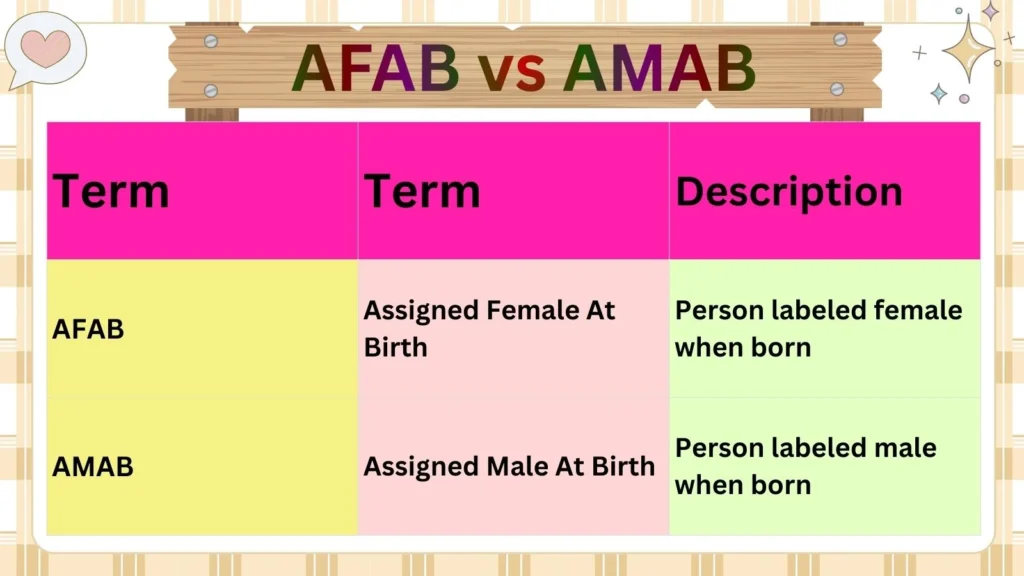
To better understand AFAB meaning, it helps to compare it with another commonly used acronym: AMAB.
| Term | Meaning | Description |
|---|---|---|
| AFAB | Assigned Female At Birth | Person labeled female when born |
| AMAB | Assigned Male At Birth | Person labeled male when born |
AFAB in Education and Awareness
Educational content sometimes uses the term when discussing social experiences connected to birth assignment.
This helps writers describe patterns or experiences without making assumptions about identity.
For example, discussions might mention:
- AFAB childhood expectations
- AFAB social experiences
- AFAB representation
These discussions focus on experiences rather than identity labels.
FAQs:
What does AFAB mean?
AFAB means Assigned Female At Birth. It describes someone who was labeled female when they were born.
Is AFAB the same as being a woman?
No. AFAB describes birth assignment, while gender identity can be different.
Where is AFAB commonly used?
The term appears in identity discussions, educational articles, and social media conversations.
Why do people use AFAB?
It allows people to talk about birth assignment without making assumptions about gender identity.
Is AFAB respectful language?
Yes. Many communities use it because it helps create clear and respectful discussions.
Conclusion:
The AFAB meaning is simple yet important. It stands for Assigned Female At Birth and describes the classification given to someone when they are born.
However, it does not define who someone is or how they identify.
Understanding this term helps create clearer conversations about identity, experiences, and social expectations.
Language continues to evolve, and terms like AFAB help people describe themselves with accuracy and respect.

I am Jonathon Dorofy and i am SEO content writer and meanings expert who specializes in internet slang, texting abbreviations, and modern language trends. He creates well-researched, easy-to-understand content that helps readers quickly learn the meaning of words, acronyms, and online expressions. With a strong focus on accuracy, user intent, and Google SEO best practices, Jonathon delivers trustworthy content designed to simplify digital communication for a global audience.