Admin meaning is a term you’ve probably seen everywhere – from workplace emails to social media groups.
But what does it really mean? Understanding the role, responsibilities, and origin of an admin can empower you in professional settings and digital spaces.
In this guide, we’ll break down everything about admins with real-life examples, tables, and pro tips! 🚀
What Does Admin Mean? 🤔
The term admin is short for administrator. An admin is someone who manages, organizes, or oversees a system, network, organization, or online group. The context determines whether it’s a technical, organizational, or social admin. Here’s a quick breakdown:
- Technical Admin: Manages computer systems, networks, or software platforms.
- Organizational Admin: Handles tasks like scheduling, data management, and office operations.
- Social Media/Admin in Groups: Moderates communities, approves members, and maintains order online. 🌐
Origin of the Term Admin 📜
The word administrator comes from Latin administrare, meaning “to manage” or “to serve.” Over time, it became shortened to admin in modern English, especially in digital communication. Today, the term is widely used in IT, business, education, and social media.
Timeline of Admin Evolution ⏳
| Era | Admin Role |
|---|---|
| Pre-1900s | Clerical and office management roles in organizations |
| 1900s–1980s | Administrative roles expanded to include system management and corporate operations |
| 1990s | IT admins emerged to manage computer networks |
| 2000s–Present | Admins in online communities, social media, and cloud platforms became essential |
Roles and Responsibilities of an Admin 🛠️
Admins perform a wide range of tasks depending on their field. Here are common responsibilities:
- System Management: Maintaining software, hardware, and network systems.
- Data Organization: Keeping files, records, and schedules accurate.
- Security: Protecting data and managing access permissions. 🔒
- Communication: Coordinating between teams or community members.
- Decision-Making: Ensuring smooth operations and resolving conflicts.
Types of Admin Roles 💼
Admins can specialize depending on their industry:
- IT Admin: Manages servers, networks, and IT infrastructure.
- Office Admin: Oversees office management and clerical duties.
- Database Admin (DBA): Maintains databases and ensures data integrity.
- Community Admin: Moderates online forums, social media groups, and virtual communities.
Real-Life Examples of Admin Tasks 📋
- Setting up user accounts and access controls in a company network.
- Organizing schedules, meetings, and deadlines for an office team.
- Moderating comments and posts in a Facebook or WhatsApp group.
- Creating and maintaining cloud storage databases.
Why Admins Are Important 🌟
Admins are the backbone of any system – digital or organizational. Their importance includes:
- Operational Efficiency: Streamlines processes for smooth workflow.
- Security: Prevents unauthorized access and data breaches.
- Conflict Resolution: Maintains order and handles issues swiftly. ⚡
- Support: Provides guidance and solutions to users or team members.
Skills Required to Be a Successful Admin 🧠
Being an admin requires a mix of technical, organizational, and soft skills:
- Technical Skills: IT knowledge, database handling, and troubleshooting.
- Organizational Skills: Task management, scheduling, and prioritization.
- Communication Skills: Clear coordination and conflict resolution. 🗣️
- Problem-Solving: Ability to manage unexpected issues efficiently.
Admin in Digital Communication 💻
In online platforms, admins ensure communities function smoothly. Examples include:
- Approving or removing group members.
- Moderating posts to prevent spam or harmful content.
- Providing guidance or rules for community conduct.
Popular Platforms Where Admins Are Essential 🌐
- Facebook Groups
- Discord Servers
- WhatsApp Groups
- Slack Workspaces
- Company Intranets and Internal Tools
Common Misconceptions About Admin Roles ❌
- Misconception 1: Admins only give permissions – In reality, they manage systems, solve issues, and ensure security.
- Misconception 2: Admin is an easy job – Many admin roles require multitasking, technical skills, and decision-making.
Admin in Popular Culture 🎬
Admins have become iconic in pop culture as the “behind-the-scenes” heroes. They appear in movies, series, and memes as:
- Network tech wizards fixing everything remotely
- Community moderators keeping online spaces friendly
- Corporate problem-solvers managing chaos efficiently 💼
Examples of Admin Terminology in Daily Life 📝
- “I need the admin to reset my password.”
- “Contact the office admin for schedule changes.”
- “The group admin removed spam messages promptly.”
Admin Responsibilities Table 📊
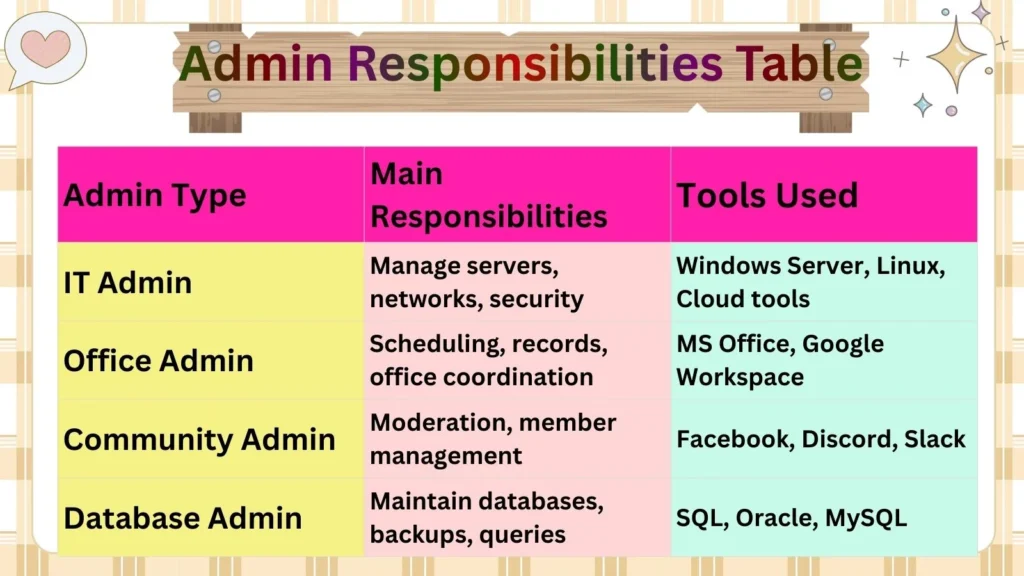
| Admin Type | Main Responsibilities | Tools Used |
|---|---|---|
| IT Admin | Manage servers, networks, security | Windows Server, Linux, Cloud tools |
| Office Admin | Scheduling, records, office coordination | MS Office, Google Workspace |
| Community Admin | Moderation, member management | Facebook, Discord, Slack |
| Database Admin | Maintain databases, backups, queries | SQL, Oracle, MySQL |
FAQs:
1. What is the full meaning of Admin?
Admin stands for Administrator, someone who manages or oversees systems, organizations, or communities.
2. What are the key responsibilities of an Admin?
Admins handle management, organization, security, communication, and decision-making tasks depending on their role.
3. Can anyone become an Admin?
While technically anyone can, successful admins require specific skills like technical knowledge, organization, and communication. 🧩
4. Is Admin only for IT roles?
No, admins exist in offices, online communities, and organizations beyond IT.
5. Why is an Admin role important?
Admins maintain order, security, and efficiency in systems, communities, and workplaces.
Conclusion:
The term admin meaning is versatile but essential.
Admins play a pivotal role in organizations, IT systems, and digital communities.
They ensure smooth operations, enforce rules, provide security, and manage data efficiently.
Whether you’re an office worker, IT professional, or online community member, understanding admin responsibilities can help you appreciate their crucial role. 🌟

I am Jonathon Dorofy and i am SEO content writer and meanings expert who specializes in internet slang, texting abbreviations, and modern language trends. He creates well-researched, easy-to-understand content that helps readers quickly learn the meaning of words, acronyms, and online expressions. With a strong focus on accuracy, user intent, and Google SEO best practices, Jonathon delivers trustworthy content designed to simplify digital communication for a global audience.