AKA meaning is one of the most widely used abbreviations in everyday language, online chats, social media, and formal writing.
Whether you’ve seen it in a legal document, a text message, or a celebrity bio, understanding AKA can save confusion and help you communicate clearly.
In this guide, we’ll dive deep into AKA – its origin, common uses, slang applications, examples, and more – all explained in a friendly, easy-to-understand way. 🌟
What Does AKA Stand For? 🤔
AKA stands for “Also Known As”. It is used to indicate an alternative name, alias, nickname, or pseudonym.
The abbreviation is versatile and appears in formal documents, online content, and casual conversations. Let’s break it down:
- Formal Use: Legal documents, contracts, or professional profiles often use AKA to clarify identities.
- Informal Use: Social media bios, gaming names, and online forums frequently use AKA to introduce nicknames or usernames.
Origin of AKA 🏷️
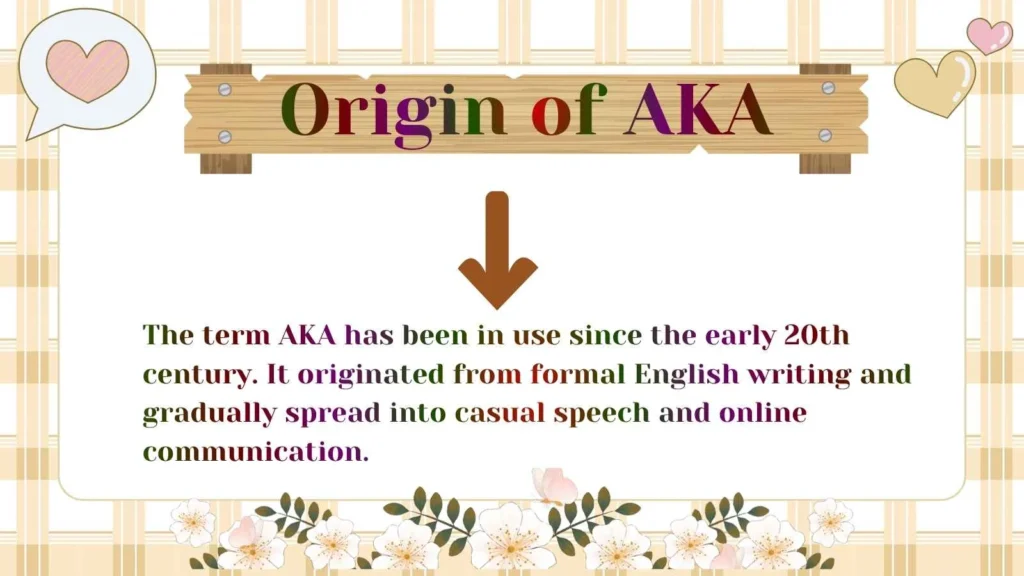
The term AKA has been in use since the early 20th century. It originated from formal English writing and gradually spread into casual speech and online communication.
Its concise, three-letter structure made it ideal for shorthand writing and digital conversations. 💬
Historical Timeline ⏳
| Year | Significant Use |
|---|---|
| 1900s | AKA appears in legal and official documents |
| 1920s–1950s | Used in biographies and professional profiles |
| 1990s | Adopted by the internet and online forums |
| 2000s–Present | Common in social media, texting, and informal communication |
How AKA Is Used in Sentences 📝
Using AKA correctly is key to sounding professional or clear. Here are some examples:
- “John Smith, AKA Johnny, will lead the project.”
- “The artist Lady Gaga, AKA Stefani Germanotta, is performing tonight.”
- “The hacker AKA CyberGhost has been traced.”
AKA in Pop Culture 🌟
In pop culture, AKA is often used to highlight a famous alias or stage name. Musicians, actors, and authors frequently appear with AKA in media headlines. Examples include:
- Marshall Mathers, AKA Eminem
- Reginald Dwight, AKA Elton John
AKA in Social Media and Online Slang 💬
Online, AKA helps users introduce usernames, gamer tags, or online personas. It’s common in bios, gaming platforms, and meme captions:
- “Alex, AKA DarkKnight123, just reached level 100! 🕹️”
- “Emily, AKA @SunshineVibes, shared her new artwork.”
Formal vs Informal Usage ⚖️
Understanding the difference is important:
- Formal: Legal documents, publications, and biographies. Always capitalize: AKA.
- Informal: Texts, chats, and social media posts. Can appear as aka or AKA.
Common Mistakes to Avoid ❌
Many people misuse AKA or confuse it with similar abbreviations. Avoid these mistakes:
- Using AKA in place of “aka” in casual chat is acceptable, but avoid in formal writing.
- Do not confuse AKA with “AFK” (Away From Keyboard) or other acronyms.
- Always place AKA between the real name and alias: Correct → John Doe, AKA Johnny
Why AKA Is Important in Communication 📌
AKA clarifies identity, prevents misunderstandings, and provides context. In professional writing, it ensures legal clarity; in social media, it connects real names to online personas.
Examples of Professional Use 💼
- “Mary Johnson, AKA MJ, signed the contract.”
- “The suspect, AKA Red Fox, was apprehended.”
Fun Facts About AKA 🎉
- AKA is used globally across languages with English influence.
- Some people creatively use AKA in brand names and artistic personas.
- It is recognized in dictionaries and style guides worldwide.
AKA in Entertainment and Gaming 🎮
Gamers, YouTubers, and influencers often use AKA to link their real names to online identities. Example:
- “Michael, AKA ShadowSniper, streams daily on Twitch.”
- “Sophie, AKA StarryNight, posted a new video tutorial.”
Tables of AKA Usage Platforms 🗂️
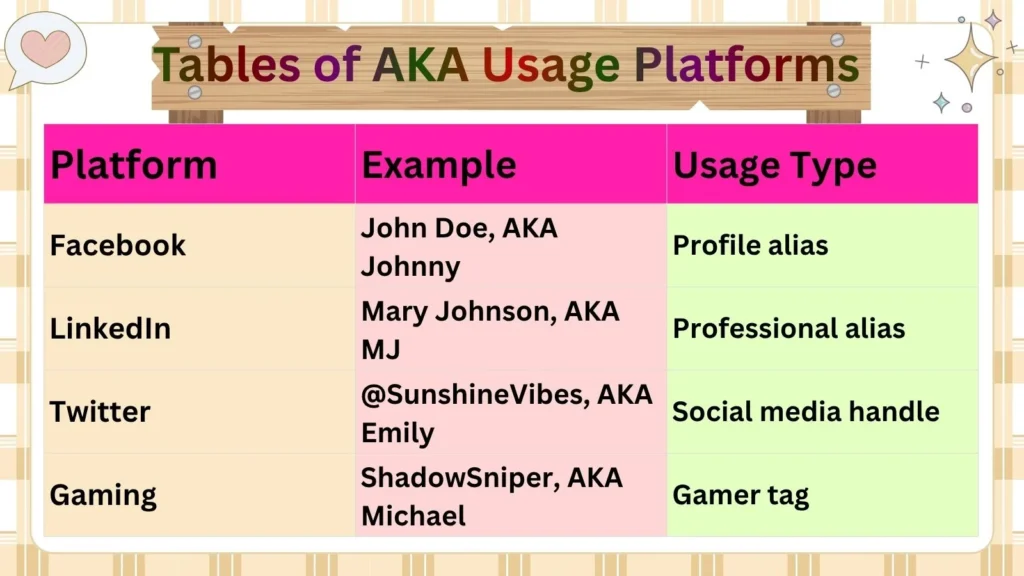
| Platform | Example | Usage Type |
|---|---|---|
| John Doe, AKA Johnny | Profile alias | |
| Mary Johnson, AKA MJ | Professional alias | |
| @SunshineVibes, AKA Emily | Social media handle | |
| Gaming | ShadowSniper, AKA Michael | Gamer tag |
Tips to Use AKA Effectively ✅
- Always clarify the real name first, then the alias.
- Use AKA to introduce yourself or someone else in formal and informal contexts.
- Keep punctuation correct: commas before and after AKA when used in a sentence.
FAQs:
1. What does AKA mean?
AKA means “Also Known As”, used to indicate an alias, nickname, or pseudonym.
2. Can AKA be used informally?
Yes, it’s commonly used in texts, social media, and gaming, but maintain proper punctuation for clarity.
3. Is AKA a recent abbreviation?
No, AKA has been in use since the early 20th century and became more popular online in the 1990s.
4. How do I write AKA correctly?
Always capitalize in formal writing: AKA. Place it between the real name and the alias with commas.
5. Can AKA be used for brands or nicknames?
Yes, many brands, artists, and influencers use AKA to highlight stage names or online personas. 🌟
Conclusion:
AKA meaning is simple yet incredibly versatile.
From legal documents to social media bios, AKA connects real identities with aliases, nicknames, and pseudonyms.
Understanding its proper usage helps you communicate clearly, professionally, and confidently.
Remember to follow punctuation rules and context, and AKA will always make your writing crisp and accurate. ✨

I am Jonathon Dorofy and i am SEO content writer and meanings expert who specializes in internet slang, texting abbreviations, and modern language trends. He creates well-researched, easy-to-understand content that helps readers quickly learn the meaning of words, acronyms, and online expressions. With a strong focus on accuracy, user intent, and Google SEO best practices, Jonathon delivers trustworthy content designed to simplify digital communication for a global audience.