AFK meaning is one of the most common abbreviations you’ll encounter in online chats, gaming communities, and social media platforms.
Whether you’re playing your favorite game, chatting with friends, or browsing forums, understanding AFK is essential for clear communication.
In this comprehensive guide, we’ll cover everything: from the origin of AFK, its practical usage, examples in different contexts, to tips on using it effectively. 💬🎯
What Does AFK Stand For? 🤔
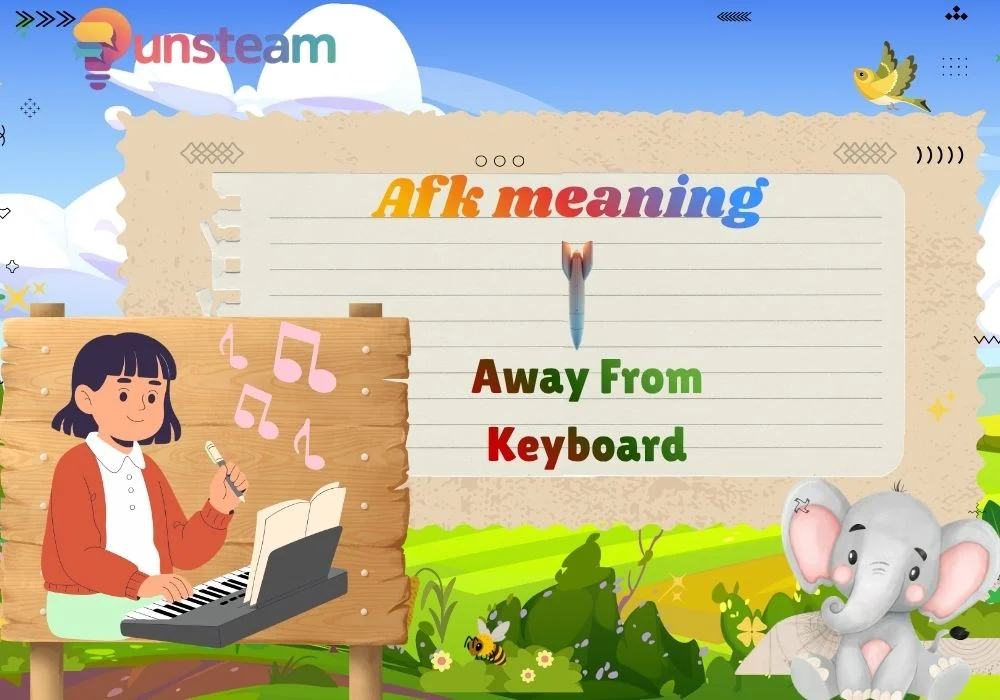
The abbreviation AFK stands for “Away From Keyboard”. It is widely used to indicate that a person is temporarily unavailable or not actively interacting with their device.
The term originated in early online chatrooms and gaming communities, where instant communication required quick updates about user activity. ⌨️
Different Contexts of AFK Usage 📝
- Gaming: Players use AFK to inform teammates they are stepping away temporarily.
- Online Chat: In chat platforms, AFK signals that the user is inactive but may return soon.
- Professional/Remote Work: Occasionally used in workplace messaging to indicate short breaks. 🕒
Origin of AFK 📜
The term AFK first appeared in early online forums and multi-user dungeons (MUDs) in the 1980s. Gamers and chat enthusiasts needed a shorthand for moments when they were temporarily unavailable. Over time, AFK became standard across:
- Instant messaging platforms
- MMORPGs (Massively Multiplayer Online Role-Playing Games)
- Social media apps and online forums
How to Use AFK in Online Conversations 💬
Using AFK correctly ensures smooth communication. Here are some examples:
- “BRB, going AFK for 5 mins!”
- “Sorry team, I’ll be AFK during the next round 🕹️”
- “AFK – grab some snacks, back in 10!”
AFK in Gaming 🎮
In online gaming, AFK has a special significance. Leaving a game without informing teammates can affect strategy and rankings. Therefore, clear communication is key:
- MMORPGs: Players mark themselves AFK while managing real-life activities.
- Team-based games: Teammates need to know if someone is AFK to adjust tactics.
- Competitive games: AFK can result in penalties or temporary bans in professional scenarios. ⚠️
Examples in Popular Games 🕹️
- “I’ll be AFK during boss fight, heal yourselves!”
- “AFK in lobby, don’t start without me!”
- “AFK farming – come back in 10 mins”
Common Misconceptions About AFK ❌
Despite its simplicity, some users misunderstand AFK:
- Misconception 1: AFK means disconnected – in reality, it only indicates temporary absence.
- Misconception 2: Only gamers use AFK – it is now common in chats and workplace messaging.
- Misconception 3: AFK is unprofessional – when used correctly, it’s a clear and polite communication tool. ✅
AFK vs BRB vs Idle ⏸️
It’s important to distinguish AFK from similar terms:
- AFK (Away From Keyboard): Temporarily inactive but will return
- BRB (Be Right Back): Short-term absence, usually informal
- Idle: System-detected inactivity, not necessarily voluntary
AFK Etiquette and Best Practices 📝
Following proper AFK etiquette improves communication:
- Inform others: Always notify teammates or chat participants before going AFK.
- Set a timer: Estimate your return time to manage expectations.
- Don’t abuse: Extended AFK periods can disrupt team games or group chats. 🚨
Fun Facts About AFK 🎉
- AFK is recognized in dictionaries like Oxford and Merriam-Webster due to widespread use.
- Streamers often display “AFK” on-screen to inform viewers.
- AFK has inspired memes, merchandise, and even in-game emotes. 😎
AFK in Workplace and Remote Communication 💻
AFK isn’t limited to games; it’s increasingly used in professional settings:
- During video conferences, messaging apps like Slack and Teams use AFK to show brief absence.
- Indicates break periods without causing confusion.
- Encourages clear, concise communication while working remotely. 🏢
AFK in Social Media and Chats 📱
On platforms like Discord, WhatsApp, or Reddit, AFK is a standard shorthand:
- Signifies short-term unavailability
- Keeps group chats organized and informed
- Commonly used with emojis to indicate mood or activity: “AFK 🍕 – grabbing dinner”
Timeline of AFK Adoption ⏳
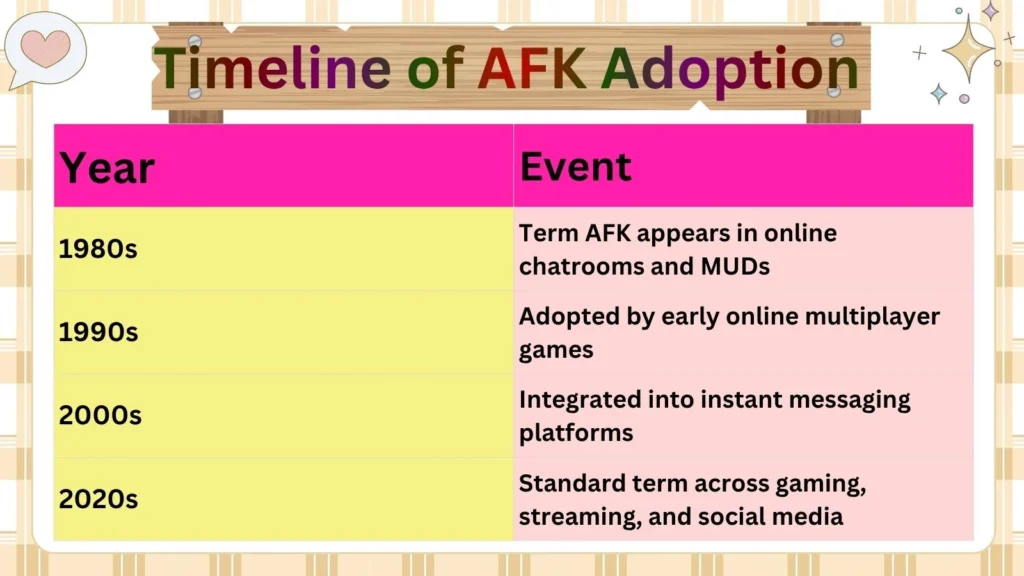
| Year | Event |
|---|---|
| 1980s | Term AFK appears in online chatrooms and MUDs |
| 1990s | Adopted by early online multiplayer games |
| 2000s | Integrated into instant messaging platforms |
| 2020s | Standard term across gaming, streaming, and social media |
Why AFK Remains Relevant Today 🌟
Even with mobile notifications and constant connectivity, AFK stays relevant because:
- Quickly informs others of temporary absence
- Prevents misunderstandings in games and group chats
- Balances real-life activities with online presence
FAQs:
1. What does AFK stand for?
AFK means Away From Keyboard. It indicates temporary inactivity in gaming, chats, or online platforms.
2. Can AFK be used outside gaming?
Yes! AFK is now common in online chats, social media, and remote work messaging to indicate brief absence.
3. How long is considered AFK?
There’s no fixed duration. AFK typically refers to any temporary break, from a few minutes to longer periods, depending on context.
4. Is AFK professional?
Yes, when used appropriately in workplace tools, AFK communicates temporary unavailability politely.
5. What’s the difference between AFK and idle?
AFK is voluntary absence, while idle refers to system-detected inactivity regardless of user intention.
Conclusion:
The abbreviation AFK plays a crucial role in online communication.
From gaming and social media to professional environments, knowing AFK meaning ensures clarity and smooth interaction.
Whether you’re stepping away from a keyboard or a game, informing others prevents confusion and maintains etiquette. 💡
Understanding AFK isn’t just about knowing the letters—it’s about mastering online etiquette, respecting team dynamics, and balancing your real-life commitments with digital engagement. 🌟

I am Jonathon Dorofy and i am SEO content writer and meanings expert who specializes in internet slang, texting abbreviations, and modern language trends. He creates well-researched, easy-to-understand content that helps readers quickly learn the meaning of words, acronyms, and online expressions. With a strong focus on accuracy, user intent, and Google SEO best practices, Jonathon delivers trustworthy content designed to simplify digital communication for a global audience.