Have you ever received a message that simply says “ion” and felt completely confused?
😵 You’re not alone. Modern texting language is full of shortcuts, slang, and creative spellings that can leave even experienced texters scratching their heads.
Understanding ion meaning in text is important if you want to keep up with today’s fast-moving digital conversations.
In this detailed guide, we’ll explore what ION really means, where it comes from, how people use it in casual chats, and how you can respond naturally.
By the end, you’ll feel confident using and recognizing ION in everyday messaging. 🚀
What Does ION Mean in Text? 🤔
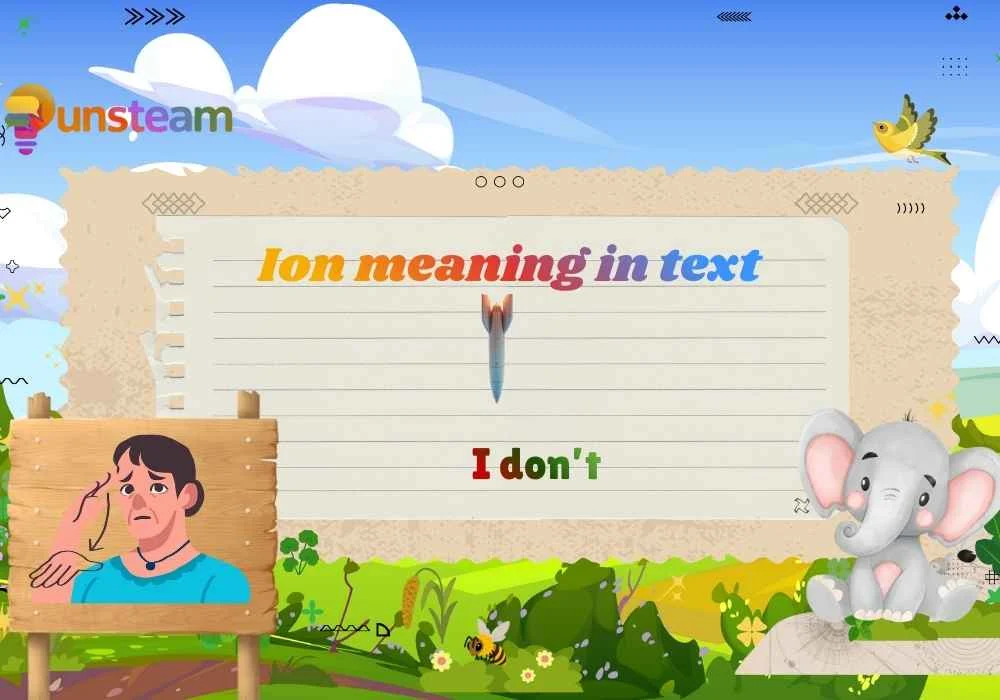
ION is a slang spelling of the phrase “I don’t”.
Instead of typing “I don’t,” many people shorten it to ion to sound more casual and conversational.
ION = I don’t
This slang is especially common in informal texting, social media chats, and online conversations.
ION Meaning Explained Simply 🧠
When someone writes ion, they are saying:
- I don’t know
- I don’t care
- I don’t think so
- I don’t want to
The exact meaning depends on what comes after ion.
Examples:
- Ion know → I don’t know
- Ion care → I don’t care
- Ion wanna go → I don’t want to go
Origin of ION Slang 📜
The slang ion originated from spoken language, where people naturally pronounce “I don’t” quickly, making it sound like “ion.” Over time, this pronunciation moved into text form.
It became popular in:
- Urban online communities
- Social media platforms
- Text messaging culture
Today, ion is widely recognized as casual shorthand for “I don’t.”
Why People Use ION in Texting 💬
People prefer ion because:
- It’s faster to type ⌨️
- It sounds natural 🗣️
- It feels casual 😎
- It matches modern slang style
Using ion helps messages feel relaxed and conversational.
ION Usage Examples in Conversations ✍️
| Message | Meaning |
|---|---|
| Ion know what to do | I don’t know what to do |
| Ion care anymore | I don’t care anymore |
| Ion wanna go out | I don’t want to go out |
| Ion think so | I don’t think so |
Different Ways ION Is Used 🔄
ION can appear in many sentence structures:
- At the beginning of a sentence
- In the middle of a sentence
- As part of a reply
Examples:
- Ion feel good today
- If he asks, ion going
- Ion really care
ION vs IDK vs IDC ⚖️
| Slang | Meaning | Usage |
|---|---|---|
| ION | I don’t | General negative statement |
| IDK | I don’t know | Lack of knowledge |
| IDC | I don’t care | No concern |
ION is broader and works with many phrases.
Is ION Formal or Informal? 🧾
ION is completely informal.
- Great for friends
- Okay for casual chats
- Not suitable for work emails
Use standard grammar in professional communication.
How to Respond When Someone Says ION 💭
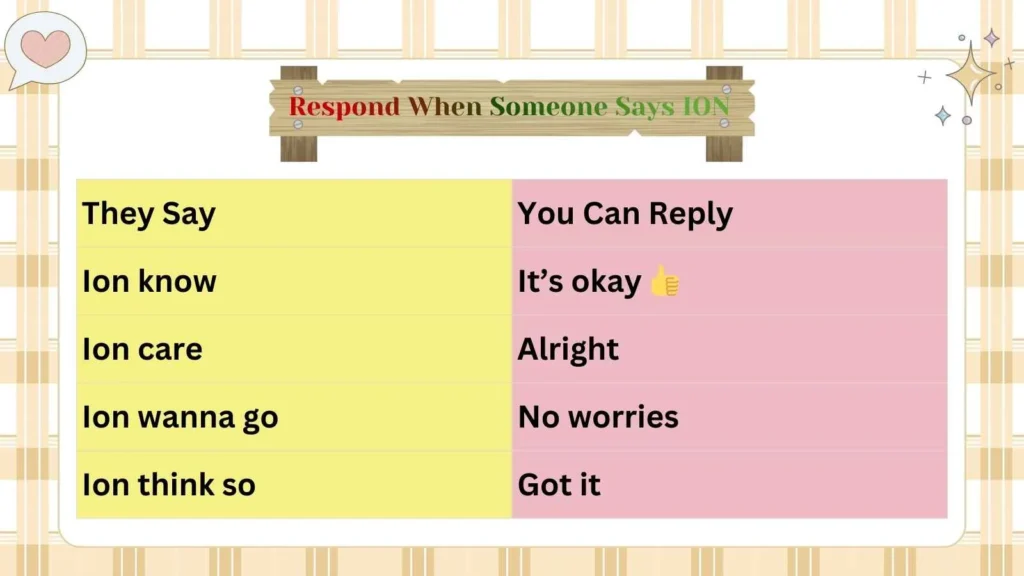
| They Say | You Can Reply |
|---|---|
| Ion know | It’s okay 👍 |
| Ion care | Alright |
| Ion wanna go | No worries |
| Ion think so | Got it |
Common Variations of ION 🔤
- Ion kno
- Ion wanna
- Ion even care
- Ion really know
All versions keep the same meaning.
ION in Social Media Messages 📱
ION appears frequently in:
- DMs
- Comments
- Group chats
It is less common in public posts but still appears.
Why Understanding ION Matters 🚀
Knowing slang like ION helps you:
- Avoid confusion
- Understand younger users
- Communicate faster
- Stay current
Related Slang You May Like 🔗
Want to explore more slang meanings? Here’s an example format:
FAQs:
What does ION mean in text?
ION means I don’t.
Is ION rude?
No, it is casual slang.
Can I use ION with anyone?
Use it only in informal conversations.
Is ION the same as IDK?
No. ION means I don’t, while IDK means I don’t know.
Why do people spell I don’t as ION?
Because it matches how it sounds when spoken quickly.
Conclusion:
Understanding ion meaning in text gives you a clear advantage in modern digital communication.
The slang ION simply replaces the phrase I don’t, making messages shorter, faster, and more conversational.
While it’s not appropriate for formal situations, it fits perfectly in casual chats with friends and online communities.
As texting language continues to evolve, learning small slang terms like ION can make a big difference.
You’ll read messages more accurately, respond more naturally, and feel more confident in online conversations.

I am Jonathon Dorofy and i am SEO content writer and meanings expert who specializes in internet slang, texting abbreviations, and modern language trends. He creates well-researched, easy-to-understand content that helps readers quickly learn the meaning of words, acronyms, and online expressions. With a strong focus on accuracy, user intent, and Google SEO best practices, Jonathon delivers trustworthy content designed to simplify digital communication for a global audience.